Count before you judge
The board is shared information. Every active player can use its community cards, but the way those cards combine with private cards depends on the variant. In Hold’em, use any five from the seven available cards. In four-card Omaha, use exactly two private cards and three from the board.
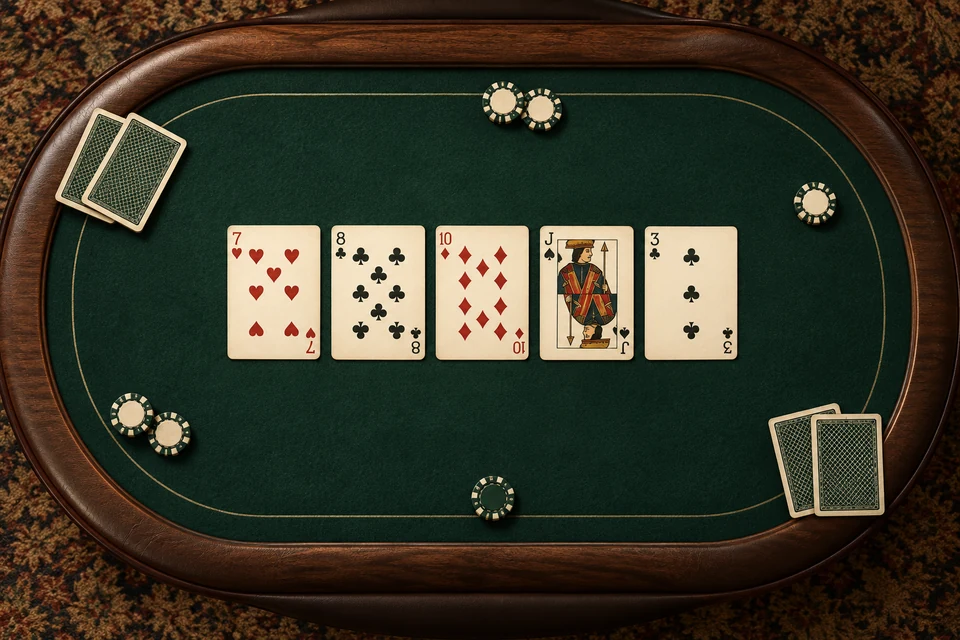
Start by counting the visible board cards, then inspect ranks and suits separately. A promising possibility is not a completed combination. Three hearts do not make a flush, and three consecutive ranks do not make a straight.
Notice ranks and suits
Take K♣ 8♦ 2♥. The ranks are separated and all three suits differ: this is a rainbow flop. Now compare 9♥ 10♥ J♣. The ranks connect and two hearts are present. These patterns create different possible combinations, even though each board still contains only three cards.
“Connected” and “rainbow” describe the cards, not an opponent’s holding. On the second flop, Q♠ 8♦ would already form a queen-high straight. A♣ K♦ would not: it has no queen to connect its king with the board’s jack, ten and nine. Reading all five ranks prevents a loose visual impression from becoming a false hand.
Check a possible flush
Suppose the final board is A♥ J♥ 8♥ 5♣ 2♦. In Hold’em, a player needs two hearts among their hole cards to make a flush because the board supplies only three. K♥ Q♠ has four hearts available in total and therefore does not have a flush.
With a board of A♥ J♥ 8♥ 5♥ 2♦, one heart in a Hold’em hand can complete five. These are different boards. Do not carry an assumption from one example into the next, or assume that the number of red cards equals the number of hearts.
Read paired boards carefully
A pair on the board can be part of several hand categories. On Q♣ Q♦ 7♥ 2♠ 9♣, a player with 7♣ 7♦ makes 7♣ 7♦ 7♥ Q♣ Q♦: a full house. A player with Q♥ A♣ has three queens, an ace and a nine. The full house wins because its category outranks three of a kind.
This is a useful reminder to identify the category before comparing a conspicuous rank. Seeing three queens can look stronger than seeing three sevens, but the sevens form part of a five-card full house in this example.
Write down the best five
- Check how many hole cards the variant requires.
- List the strongest legal five-card combination.
- Name its category using the hand rankings.
- Compare category and relevant ranks against the other eligible hands.
- Ignore cards that do not fit inside the best five.
A complete five-card straight has no extra kicker. When both players’ best five ranks match, a spare ace cannot turn the tie into a win. This method works equally well when reviewing an old hand history or studying a diagram: count, form the legal five, and only then decide what beats what.