Your best five cards count
At showdown in standard high-hand poker, compare five-card hands. Start with the hand category, then compare card ranks if the categories match. A higher category wins even when the individual cards in the lower category look impressive: three twos beat two pair made from aces and kings.
These rankings apply to ordinary Texas Hold’em and Omaha high. Lowball, hi/lo and short-deck games need their own rules. In Hold’em, your best five can include both hole cards, one, or neither. In Omaha, you must use exactly two hole cards and three board cards.
The order, strongest first
| Hand | What it contains | Example |
|---|---|---|
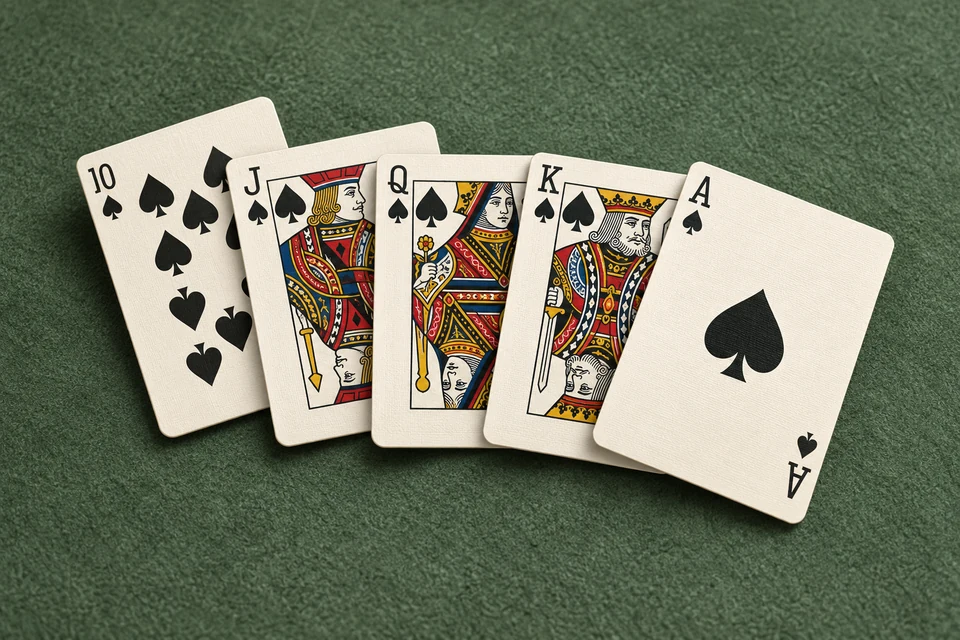
| Royal flush | Ace-high straight flush | A♠ K♠ Q♠ J♠ 10♠ |
| Straight flush | Five consecutive ranks, one suit | 9♥ 8♥ 7♥ 6♥ 5♥ |
| Four of a kind | Four equal ranks and a side card | Q♣ Q♦ Q♥ Q♠ 2♣ |
| Full house | Three equal ranks plus a pair | 8♣ 8♦ 8♥ K♠ K♦ |
| Flush | Five cards of one suit | A♥ J♥ 8♥ 5♥ 2♥ |
| Straight | Five consecutive ranks | 9♣ 8♦ 7♠ 6♥ 5♣ |
| Three of a kind | Three equal ranks and two side cards | 7♣ 7♦ 7♥ K♠ 2♠ |
| Two pair | Two separate pairs and a side card | J♣ J♦ 4♠ 4♥ A♣ |
| One pair | One pair and three side cards | 10♣ 10♦ A♥ 8♠ 3♣ |
| High card | No pair, straight or flush | A♣ J♦ 8♥ 6♠ 2♣ |
A royal flush is the highest straight flush, usually given its own line in a beginner’s chart. The flush and straight examples above deliberately avoid also being straight flushes.
Compare matching categories
Compare the important group first: the pair in a one-pair hand, the three matching cards in a full house, or the highest pair in two pair. If that ties, continue through the remaining relevant ranks. For a flush, compare the highest card, then the next highest, until the five cards differ.
A kicker is a side card inside the five-card hand. Suppose a Hold’em board is K♣ 9♦ 7♥ 4♠ 2♣. A player holding K♦ A♥ beats K♠ Q♥: both have kings, but the ace is the higher first kicker. The winning five are K♣ K♦ A♥ 9♦ 7♥.
Aces, suits and shared hands
An ace can finish A-K-Q-J-10 or start A-2-3-4-5. The latter is a five-high straight. An ace cannot turn the corner: Q-K-A-2-3 is not a straight. Suits do not outrank one another when deciding the strength of a standard high hand.
If the best five ranks are identical, the hands tie. There is no sixth-card tiebreaker. On a board of 5♠ 6♥ 7♣ 8♦ 9♥, A♣ K♣ and Q♠ 2♦ both play the same nine-high straight. The ace does not win anything extra. The tied players share the pot, subject to the room’s odd-chip rules.
Check the actual combination
When reviewing a hand, write its five cards down. Count them, check the category, and put the ranks in comparison order. This avoids common mistakes such as calling four suited cards a flush or using an extra side card to break a shared straight. Our board-reading examples put that method to work.