The combination rule comes first
Standard four-card Omaha high deals four private cards to each player and uses a five-card community board. To make a hand, choose exactly two of the private cards and exactly three from the board. That gives five cards in total.
This differs from Hold’em, where either, both or neither of the two hole cards may play. In Omaha you cannot use only one hole card, cannot use three, and cannot simply play all five board cards. Four starting cards give more possible combinations; they do not give permission to ignore the two-plus-three rule.
The familiar sequence
The community cards arrive as a three-card flop, a one-card turn and a one-card river, with betting before the flop and after each group. The button and blinds establish the order. At showdown in Omaha high, eligible players compare traditional high poker hands formed using the required combination.
Omaha is often played pot-limit, but the variant and the betting structure are separate descriptions. Check whether the stated game is pot-limit, fixed-limit or another format. Omaha hi/lo introduces separate low-hand conditions and is outside this introduction.
One heart is not enough
Imagine your private cards are A♥ K♣ Q♦ J♠. The board finishes 2♥ 5♥ 9♥ K♦ Q♣. You have only one heart among your hole cards, so you cannot make a heart flush: a legal flush here would need two private hearts and three shared hearts.
You can use K♣ Q♦ with K♦ Q♣ 9♥ to make two pair, kings and queens, with a nine. That combination contains exactly two private cards and exactly three board cards. Picking A♥ together with the three board hearts would leave only four hearts anyway, but the required private-card count is the important check.
A legal five-card example
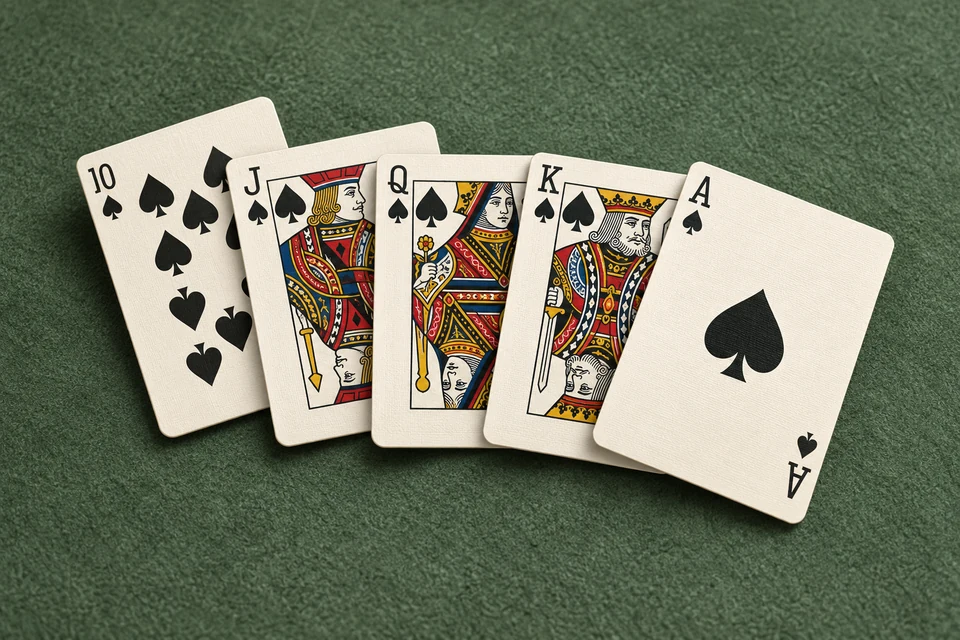
Now take A♠ A♦ K♠ K♦ as your private cards, with Q♠ J♠ 10♠ 2♣ 2♦ on the board. A♠ K♠ plus Q♠ J♠ 10♠ makes a royal flush. It uses precisely two hole cards and three board cards, so the hand is legal.
The remaining private aces and kings are alternatives, not extra cards added to that flush. Writing the selected five explicitly makes both the category and the construction visible.
Avoid the Hold’em shortcut
A quick visual scan can carry over a Hold’em habit: count all the attractive cards together and assume the strongest five can be used. In Omaha that shortcut can produce an illegal hand. Separate the private cards from the board, select two from the first group and three from the second, then evaluate the result.
For the ranking order, use our high-hand guide. For the shared-card sequence, read the Hold’em walkthrough, while remembering that its freedom to use zero, one or two hole cards does not apply here. Other Omaha variants can change the number of starting cards, so always read the game label in full.